Tiny Toy Poodles of Danville VA
where a Tiny Treasure Awaits You
Available Puppies
This chart that I use to estimate the adult weight of my puppies is a growth projection tool based on their weight at specific ages. Here's an explanation of how it works and its limitations:
How the Chart Works:
-
Age-Based Measurements: Puppies are weighed at certain milestones, such as at birth and every week after that.
-
Weight Doubling Rule: The chart uses general trends, such as doubling the weight at certain ages (e.g., doubling the 12-13-week weight gives an approximate adult weight for toy breeds when full grown).
-
Breed-Specific Adjustments: Since toy poodles and similar small breeds grow differently from larger breeds, the chart factors in their rapid early growth, which slows significantly after a few months.
-
Reference Data: The chart likely derives from historical averages and data collected from similar breed puppies and their eventual adult sizes.
Strengths:
-
Quick Estimates: It gives a rough idea of a puppy's final weight, allowing potential owners to anticipate the size of their future companion.
-
Guidance for Buyers: Helps match puppies with families looking for a specific size.
-
Breeder Insights: Assists in tracking growth patterns and identifying any anomalies.
Limitations:
-
Genetic Variability: Each puppy's growth is influenced by genetics, making exact predictions impossible. Puppies may surprise you by growing larger or staying smaller than expected.
-
Environmental Factors: Nutrition, exercise, and health can significantly impact growth.
-
Inaccuracy in Outliers: The chart may be particularly off for puppies that experience growth spurts or delays.
Practical Note:
While this chart provides an educated guess, it's not a guarantee. I emphasize this to potential buyers so they understand that the estimate is not definitive and that deviations are possible. It's a helpful tool, but the growth journey of each puppy is unique!

Puppy Aptitude Temperament Test (PATT)
At 7 weeks of age, we perform a Puppy Aptitude Temperament Test to evaluate each puppy’s natural personality, confidence, and social tendencies.
The PATT evaluates the following areas:
• Social Attraction – Measures a puppy’s natural engagement with people, including confidence and independence.
• Following – Assesses willingness to follow and connect with a person.
• Restraint – Evaluates response to gentle control and handling under mild pressure.
• Social Dominance (Response to Leadership) – Observes acceptance of gentle human guidance and interaction style.
• Elevation (Handling Tolerance) – Measures comfort when held in a position of limited control, such as during veterinary exams.
• Retrieving – Measures willingness to work cooperatively; combined with Social Attraction and Following, this helps predict ease of training.
• Touch Sensitivity – Evaluates physical sensitivity and helps guide appropriate training approaches.
• Sound Sensitivity – Assesses reaction and recovery from sudden or loud noises.
• Sight Sensitivity – Observes response to moving stimuli such as bicycles, children, or wildlife.
• Stability – Measures startle response and recovery when introduced to a novel object.
After each puppy has been evaluated, we schedule in-person visits or video calls with families to thoughtfully match each puppy with the home that fits them best.
Understanding PATT Score Patterns
The Volhard Puppy Aptitude Temperament Test uses a scoring system from 1-6. Rather than labeling puppies, we evaluate overall scoring patterns to better understand temperament tendencies and long-term placement suitability.
There are no "good" or "bad" scores - only different personality styles. Our goal is always the same: the right puppy in the right home.
Predominantly 1-2 Scores
Bold, assertive, highly confident
These puppies tend to be strong-willed, self-assured, and naturally assertive. They often display high confidence, independence, and a desire to take initiative.
These temperaments typically thrive in experienced homes that provide clear structure, consistent training, and purposeful engagement. With the right leadership and outlets, they can excel in performance, sport, or working environments.
Predominantly 3 Scores
Active, engaged, responsive
These puppies are energetic, people-oriented, and eager to learn. They tend to bond well and respond positively to training.
They do best in active homes that enjoy involvement, exercise, and continued guidance. With consistency and enrichment, they mature into capable and well-balanced companions.
A wonderful fit for committed families who enjoy participating in training and activities.
Predominantly 4 Scores
Balanced, adaptable, companion-minded
These puppies tend to be steady, cooperative, and socially comfortable. They are often naturally adaptable and responsive to gentle leadership.
These temperaments are typically ideal for companion homes, first-time owners, and families with children. With continued training and socialization, they mature into stable, affectionate, and reliable family dogs.
Predominantly 5-6 Scores
Independent, reserved, self-directed
These puppies may be more independent or less socially dependent. They often prefer autonomy and may not constantly seek interaction.
Placement requires thoughtful consideration to ensure their temperament style aligns well with the household environment. With understanding and appropriate expectations, these puppies can thrive in the right setting.
Why I Don’t Place Littermates Together 🐾
This is something I’m often asked about, and I always want to answer it with honesty and care—because it truly comes from wanting the very best for both the puppies and their families.
As much as it may seem sweet to take home two siblings, I do not place littermates together.
Why?
Because of something called littermate syndrome.
Littermate syndrome isn’t a “disease,” but rather a set of behavioral challenges that can develop when two puppies from the same litter are raised together in the same home.
These puppies can become so bonded to each other that they struggle to bond with their humans.
And while that might sound harmless at first… it often leads to challenges such as:
• Difficulty with training and focus
• Increased anxiety when separated—even briefly
• Poor social skills with other dogs
• Fearfulness or lack of confidence
• In some cases, reactivity or fighting as they mature
Instead of growing into confident, well-adjusted companions, they can become overly dependent on each other—and that can make everyday life much harder for both the puppies and their owners.
Raising one puppy already takes time, consistency, and intention.
Raising two from the same litter properly requires separate training, separate bonding time, separate outings—essentially raising them as individuals every step of the way.
And realistically, most families aren’t set up for that level of structure.
My goal is not just to send puppies home…
It’s to set them—and you—up for success for the next 10–15 years.
That means making decisions that protect their development, confidence, and long-term behavior.
If you truly have your heart set on two dogs, I’m always happy to guide you on the best way to do that successfully—whether that’s spacing them out in age or choosing the right fit for your home.
But when it comes to littermates…
I choose what’s best for the puppies every single time. ❤️🐾


Noelle and Clifford's Litter
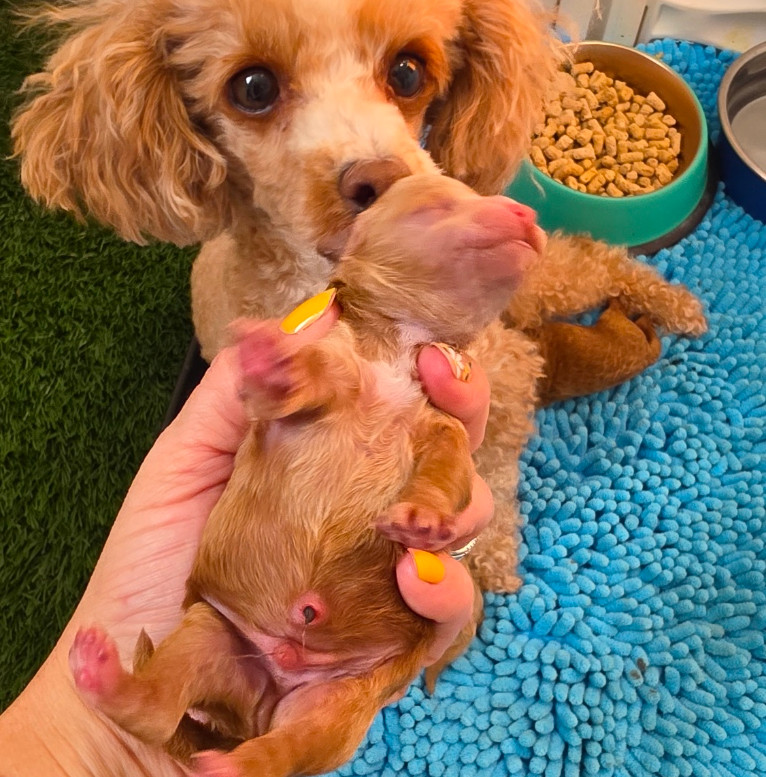
Noelle & Clifford’s beautiful litter arrived August 17, 2026! 🐩💕 Noelle gave birth to 4 absolutely gorgeous puppies — 2 girls and 2 boys!
🌸 Pink Girl — first born — 4.4 oz
💜 Purple Girl — second born — 5.5 oz
❤️ Red Boy — third born — 4 oz
💙 Blue Boy — fourth born — 6 oz
At this time, all four puppies are spoken for. If anything changes, I will update my page to reflect their availability.
🏡 Their scheduled take-home date is October 24, 2026.
Most importantly, all four babies are happy, healthy, and doing wonderfully, and Momma Noelle is doing absolutely fabulous — just as she always does. 🥰 She is truly one of the very best mommas I have, and watching how naturally and lovingly she cares for her babies never gets old.
We are so thankful for another beautiful, healthy litter and cannot wait to watch these precious little ones grow! 🐾❤️


Tinkerbell and Tamale
🐾💙✨ Tinkerbell’s Birthday Surprise Has Arrived! ✨💙🐾
Tinkerbell has delivered her precious singleton baby boy, and this little guy decided to make his entrance on an extra-special day—my birthday, August 21, 2026! 🎂🐩💕
She welcomed one handsome solid black little boy, and both momma and baby are doing wonderfully. Tinkerbell is taking great care of her tiny treasure, and he is settling into life as an only child with all of Momma’s milk, attention, and cuddles to himself. 🥰
Of course, a little boy born on my birthday needed an extra-special name. ❤️ I have officially named him:
✨ Tiny Toy Poodles’ Tiny Treasure Birthday Wish ✨
💙 Call Name: Wish
There is something incredibly special about every puppy born here, but having Wish arrive on my birthday makes him a little boy I will always remember. He truly feels like my own tiny birthday wish come true, and I couldn't have asked for a sweeter little birthday gift. 🎂💙
💕 Availability: Wish is already spoken for and has a family eagerly waiting for him.
🎂 Born: August 21, 2026
🖤 Gender/Color: Solid Black Boy
✨ Registered Name: Tiny Toy Poodles’ Tiny Treasure Birthday Wish
💙 Call Name: Wish
🏡 Estimated Take-Home Date: November 7, 2026
For now, Wish’s only jobs are to eat, sleep, grow, and soak up all of Momma Tinkerbell’s love. 💙
Stay tuned as we watch this handsome little birthday boy grow and his personality begin to shine. I have a feeling this tiny Wish is going to hold an extra-special place in my heart forever. 🐾🎂✨
Tiny Toy Poodles of Danville VA
“Where a tiny treasure awaits you.”
Looking for a furry companion with a bit more training and less of the puppy stage? Check out my Retirement Program and Guardian Home Program dogs! These amazing pups are loving, well-adjusted, and ready to bring joy to their forever families. Whether you’re searching for a retired poodle who’s ready to relax or a guardian dog with a head start in life, you’re sure to find the perfect match. Visit my Guardian Home Page or my Retired Dogs Page to learn more about these wonderful companions! 🐾❤️